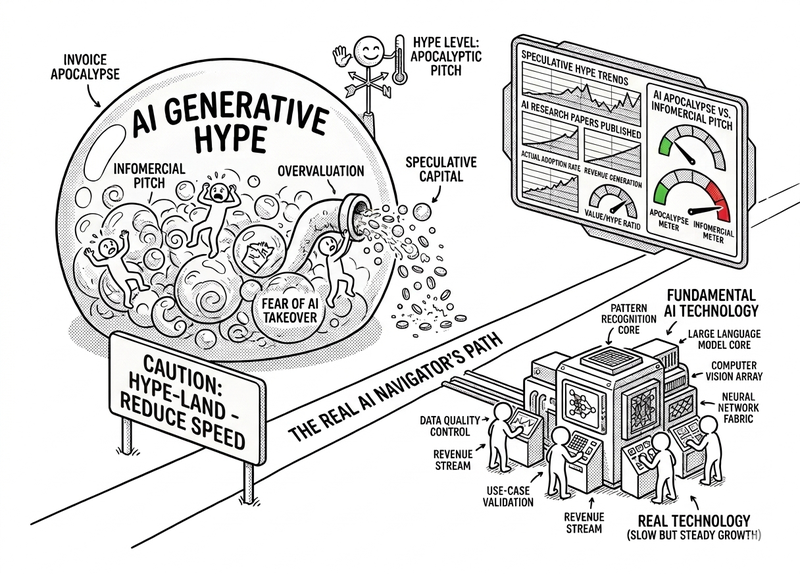
Yes, there's an AI bubble. No, it's not the end of the world.
Posted on May 21, 2026 • 14 minutes • 2806 words
Table of contents
- From dot-coms to your AI toaster
- Hype is at an all-time high: everything has AI, including your fridge
- So is there a bubble or not? The boring answer (and therefore the interesting one)
- The money: OpenAI as a symptom, and everyone else watching
- What if the bubble that pops isn’t AI, but our fantasies about it?
- Between fear and fanaticism, there’s a much more sensible position
- So what do we do in the meantime, besides blowing up balloons?
- Epilogue: yes, there’s a bubble. No, you’re not a passive spectator.
- Quick glossary
- Sources and references
Those who cannot remember the past are condemned to repeat it.
In tech, we take it one step further: we know the history, we recognize it, and we do it all over again — every decade — with the same enthusiasm that a crowd of twenty-somethings brings to an illegal New Year’s rave.
First, a shiny new toy shows up (the dot-coms, smartphones, blockchain, NFTs, now AI).
For a few years, you can’t grab a drink or sit through a meeting without someone bringing it up.
And finally, when things deflate a bit, we look around with that “nobody could have seen this coming” face while sweeping the investment party confetti off the floor.
With AI, we’re right in the middle of the “confetti flying, DJ cranking the music” phase.
From the cousin who wants to “put an AI chat widget on the website” to the self-appointed guru brother-in-law who keeps saying “if you’re not on this train you’re toast,” everyone has a very strong opinion about things they’ve never actually used beyond asking ChatGPT to write an email to their boss.
And the question any reasonably sane person starts asking is whether all of this is a bubble — or whether we just, as a species, can’t find the brakes.
It’s worth taking a calm look, without being pulled toward either extreme: not the robot apocalypse, not “this time it’s different” said with that hypnotic gleam in the eyes.
From dot-coms to your AI toaster
If you look up “AI bubble” in any serious encyclopedia, you’ll find the concept already has its own entry: the AI bubble refers to the phenomenon where expectations, investment, and marketing shoot into the stratosphere while reality moves at a much more modest pace.
Wikipedia itself describes it as a potential stock market bubble similar to the dot-com crash, fueled by a circular flow of investment among the same big tech companies buying and selling each other’s futures.
It wouldn’t be the first time.
In the ’80s and early ’90s, we went through something similar with expert systems: promises of automating complex business decisions, generous checks, packed conferences… and then years of icy cold, budget cuts, and what was later called, with a certain poetry, the “AI winter.” The technology didn’t disappear — the froth did.
If you look at Gartner’s famous Hype Cycle, you’ll find that generative AI has been happily parked on the “Peak of Inflated Expectations” for a couple of years now. That’s the point on the curve where the only annotation that’s missing is “there’s nowhere to go but down.”
First we want it for everything. Then we never want to hear about it again. And eventually we end up using it normally for a handful of things that actually deliver value.
If this all sounds like déjà vu, that’s because it is. We lived through it with dot-coms, smartphones, cloud, blockchain, and every other buzzword that’s ever been used to sell PowerPoint slides at $500 a pop.
Now it’s generative AI’s turn — and it has followed the script to the letter, including the inevitable “no, seriously, this time it’s for real” finale.
Hype is at an all-time high: everything has AI, including your fridge
At this point, if your presentation doesn’t have “powered by AI” somewhere in it, you’re barely allowed through the door.
We’ve got AI-powered CRMs, ERPs, office suites, design tools, IDEs, coffee makers, and any day now, an air fryer that recommends recipes and couples therapy.
The big consulting firm reports say the same thing in fancier words: there’s been a CAPEX explosion in AI in record time, with hyperscalers throwing money at data centers and GPUs like there’s no tomorrow, while business departments try to remember what exactly the twenty-seventh pilot of the quarter was supposed to accomplish.
Forrester was among the first to put numbers to the warning: a large chunk of enterprise AI investment was being pushed back to 2027 , because many projects never made it to production and couldn’t show any return beyond “it looked really cool in the demo.”
It’s a bit like the era when every company felt compelled to build its own mobile app: it got to the point where there were official apps for things that should have never left the browser.
Now we’re in the “everything comes with a built-in AI assistant” phase. In a few years, we’ll laugh at some of those experiments the same way we laugh today at every brain-wave from the blockchain era.
So is there a bubble or not? The boring answer (and therefore the interesting one)
Here’s the bad news for people who like simple answers: yes and no, all at once, everywhere.
On the economic front, there are bubble indicators that even the suit-and-tie analysts are starting to say out loud.
Companies like CB Insights, which track the startup and VC ecosystem, have been flagging a whole zoo of AI startups valued above $100 million, with hundreds of AI “unicorns” at $1 billion or more on paper — many of them with no profits anywhere in sight.
Months ago, experts in financial media were already openly comparing the situation to the dot-com era : lots of euphoria, sky-high multiples, and enormous faith in future profits that are, for now, exactly that — future, very very future.
Asset manager GMO, who rarely beats around the bush, put a title to the question everyone was avoiding: “Valuing AI: Extreme Bubble, New Golden Era, or Both?”
The takeaway, simplified, is that both things can be happening at the same time: strong overvaluation on top of a real underlying trend, where AI does look set to become basic infrastructure — like electricity or the internet.
And in academia, people have been saying for a while what many prefer not to hear: you have to separate the bubble of commercial expectations (startups, funding rounds, smoke and mirrors) from the technical soundness of the field itself.
The first can pop overnight; the second doesn’t vanish just because the multiples come crashing down.
We didn’t stop using email because the dot-com party ended, and we won’t stop using AI models because a funding round goes sideways.
Bottom line: yes, there’s a lot of hot air being pumped in.
But inside the balloon there isn’t only hot air: there’s also concrete, fiber, and a lot of code that’s going to stick around even after the DJ turns down the music.
The money: OpenAI as a symptom, and everyone else watching
If you want to see the tension between promise and reality condensed into a single player, look at OpenAI.
It’s the poster child of the boom, and now it’s also becoming the go-to example for everyone who talks about “the AI bubble” with that “I told you so” face.
The numbers being thrown around are not small: internal documents leaked to The Information point to projected losses of $14 billion for 2026.
The figure is staggering even for an industry used to burning money: $14 billion in a single year, with projected losses piling into the tens of billions before any hypothetical profits in the 2030s.
Some comparisons sting: more than one analyst has taken the time to point out that the total cost of the Manhattan Project or the Apollo program, adjusted for today’s dollars, is in a similar ballpark.
An Al Jazeera headline put it well: OpenAI’s “fundraising boom” is slowing down while debt and capital needs are skyrocketing.
And people are starting to wonder whether the company can sustain this burn rate without finding a business model more solid than “we’ll figure it out.”
Even the New York Times ran an opinion piece with a pretty direct headline: “This Is What Convinced Me That OpenAI Is Going to Run Out of Money.” The argument was simple: the problem isn’t the technology, it’s whether capital markets can keep financing something that burns this much cash for this long.
Meanwhile, there’s talk of massive rounds ($100 billion here, $40 billion there, deals with Nvidia, Microsoft, Amazon, Gulf sovereign wealth funds) to keep feeding the GPU-and-data-center machine.
And everyone else is watching from the sidelines: hyperscalers happy to sell them hardware and cloud capacity, regulators and economists wondering how much of this is a reasonable bet and how much is pure bubble déjà vu .
You don’t have to be a genius to see the pattern: when a company needs to raise tens of billions just to keep the lights on, while simultaneously being presented as the vanguard of the inevitable future, that sounds a lot like a balloon being inflated past its limit.
That said — and I’ll say it again — inside that balloon there are very real advances that don’t depend on whether any one company makes it out intact.
What if the bubble that pops isn’t AI, but our fantasies about it?
Here’s the interesting twist: many people who take AI seriously agree that what’s likely to pop isn’t the technology itself, but the narrative we’ve built around it.
What’s at risk of going bust is the story that “in two years there will be no programmers, lawyers, doctors, or teachers — just one big central model everyone pays a subscription to.”
It’s the idea that any company, just by “adding AI” to the product, will see its stock price multiply by five.
It’s the expectation that every human process can be reduced to a well-trained statistical prediction, with no social cost, no friction, no politics.
It doesn’t take much imagination to see where the needle might hit: tougher regulations, shortage of quality training data, unsustainable energy costs, market saturation with apps that add nothing new, or simply a market correction when CFOs start asking “and exactly how much does this add to EBITDA?”
When that happens — and some form of correction will come sooner or later — what’s left will be far less sexy for magazine covers, and far more useful.
Models embedded in workflows, no fireworks — the way nobody gets excited today that a web form validates your email in real time, even though there’s a lot of engineering behind it.
AI as plumbing, not fireworks.
Between fear and fanaticism, there’s a much more sensible position
In all this noise, there are two tribes that take up a lot of space.
On one side, the professional doomsayers, who have spent years announcing that AI is going to destroy every skilled job, that it’s the end of work as we know it, that we should probably print our résumés on cardstock before printers are outlawed.
On the other side, the infomercial evangelists, convinced that if you’re not integrating AI into everything you do — including vacuuming — you’re professionally dead; that the future belongs to whoever cranks out the most prompts per minute; and that any doubt is proof that you “just don’t get it.”
Serious research on labor impact doesn’t paint it in black and white.
McKinsey, for example, doesn’t talk about disappearing jobs but about task reconfiguration: a given role starts spending less time on repetitive work and more time on other things.
And the data from multiple sectors points the same way: the net effect isn’t a direct substitution — it’s more of an “augmentation” of the capacity of those who use AI well. Developers shipping more features with the same headcount, analysts exploring more scenarios, support teams handling more cases while — when done right — maintaining quality.
In the freelance market, data — including analysis from Brookings — points more to displacement than to annihilation: purely mechanical tasks that a model can replicate see falling prices and demand; tasks that combine AI with judgment, context, and human interaction become more valuable.
Not everyone wins — but the ground isn’t opening up under an entire generation at once, no matter how dramatic that sounds at conferences.
And this part makes nobody happy. For the skeptics, because ignoring AI and waiting for the fad to pass is a risky bet: some of this is going to stick. For the enthusiasts, because buying four tools and working the same way as before isn’t the answer either: you genuinely have to change how you work, how you measure, and where you draw the lines.
So what do we do in the meantime, besides blowing up balloons?
If by now you accept that there’s a bubble, that the underlying technology is here to stay, and that expectations will adjust sooner or later, the practical question is: what do you actually do with all this, beyond posting memes?
The same reports putting numbers on the boom offer some fairly down-to-earth clues.
The first is obvious but rarely acted on: understand what the tool does and doesn’t do, even at a surface level. Know where generative AI shines, where it falls apart, where the real risks are — instead of treating it as an infallible oracle or a toy for making (terrible) memes.
The second is to look at your own work with a critical eye: what tasks eat up your time and energy without delivering much? Repetitive documentation, reports that are variations of the same template, classifying things, tedious searches, boilerplate replies… That’s where AI tends to shine as an assistant, not as lord and master.
The third is something that rarely comes up at conferences: build skills that gain value in an AI-everywhere environment. Judgment, systems design, communication with real humans, applied ethics, the ability to anticipate second-order effects — not just “what prompt gets me more lines of code.”
In plain English: ride the wave to offload the dumb work, not to become a bit player in your own career.
Epilogue: yes, there’s a bubble. No, you’re not a passive spectator.
If after all this your takeaway is “okay, we’re blowing up another balloon, but this one has interesting stuff inside it” — you’re on the right track.
A healthy chunk of the AI startups that look unstoppable today will very likely not exist in five years. Quite likely that some current valuations will look laughable in hindsight.
And almost certainly, whatever happens in the markets, we’ll still be using versions of this technology in ten years — just like we still use the web after the dot-com bubble popped.
The difference with other bubbles is that you’re not watching this one from your couch while the evening news talks about Wall Street.
It runs through your daily life: in your IDE, your inbox, your browser, in how products are designed, decisions are made, and tasks are handed out.
You’re not a spectator — you’re part of the crowd that will decide, through small everyday choices, whether this stays a very expensive toy or becomes a genuinely useful tool.
So yes, we’re in a bubble, because we love blowing things up and then acting surprised when they go pop.
But inside the balloon there’s a technology that, properly tamed, can take some of the greyest work off our plates.
Whether that’s what actually happens — rather than a festival of smoke, layoffs, and badly justified budget cuts — depends far less on “AI” as an abstract entity, and far more on what we do with it once the spotlights go off and we have to keep doing the work.
Quick glossary
A pocket dictionary for the next time someone starts dropping buzzwords over dinner:
- AI bubble: Economic overvaluation of the AI sector, with investment and expectations far outpacing actual results.
- Hype Cycle (Gartner): Gartner’s model describing the phases of technology adoption: inflated expectations, disillusionment, and real productivity.
- Peak of Inflated Expectations: The top of the Hype Cycle; the moment when euphoria and promises hit their maximum before the correction.
- AI winter: Historical periods (1970s–80s and 1980s–90s) of investment cuts and widespread disinterest after unmet expectations.
- CAPEX: Capital expenditure; investment in physical infrastructure such as servers, data centers, and chips.
- Hyperscaler: A tech company operating infrastructure at massive scale: AWS, Azure, Google Cloud, among others.
- Generative AI: AI models capable of generating text, images, code, or other content from instructions.
- EBITDA: Earnings Before Interest, Taxes, Depreciation, and Amortization; an operational profitability metric.
Sources and references
The following articles, reports, and threads are responsible for this piece existing:
- Wikipedia EN: AI bubble
- Wikipedia ES: Burbuja de la IA
- CNBC: Are we in an AI bubble?
- Computing: AI spending boom to cool
- Fortune: AI capex growth tech stocks slow down
- Blog: 2026 AI investment slowdown
- R&D World: OpenAI $14B losses, seeking $100B
- PC Gamer: OpenAI internal documents predict $14B loss
- Unilad Tech: OpenAI projects $14B losses
- Al Jazeera: OpenAI fundraising boom slows
- New York Times (opinion): OpenAI AI bubble financing
- Sybrid: OpenAI torching $14B, 2026 crisis
- Pivot to AI: OpenAI faces cash crunch
- Reddit: OpenAI heading to biggest failure in tech
- Reddit: The AI bubble (Wikipedia thread)