The full-stack developer cult: lots of stack, not much depth
Posted on May 25, 2026 • 14 minutes • 2918 words
Table of contents
- The “full-stack developer”: a marketing invention with real consequences
- Full-stack on job boards: a one-person band with a mediocre salary
- The junior “full-stack ninja”: innocence, ego, and a whole lot of missing context
- Lots of stack, not much depth: technical debt as a business model
- Mental health: being “the one who touches everything” isn’t a superpower — it’s a recipe for burning out
- Companies: stop using “full-stack” as an organizational weapon of mass destruction
- Developers: how to stop helping build your own trap
- Toward less mythological, more functional teams
- So… is being full-stack actually bad?
- Sources and references
This article isn’t about “how to become a full-stack ninja in 12 weeks.” It’s about why that headline exists, who benefits from it, and why swallowing it whole — without thinking — is a very refined form of self-exploitation.
If you’ve been in this industry for a few years, someone has probably asked you at some point to be a “full-stack ninja, devops, cloud, data, and hey, bonus points if you know UX and SEO too.”
All for the modest price of a mediocre salary.
In this article we’re going to dissect the myth of the all-powerful full-stack developer, look at what the market data actually says, examine the damage it does to software quality and mental health — and why reasonable specialization isn’t a failure, but almost an act of professional hygiene.
The “full-stack developer”: a marketing invention with real consequences
In theory, a full-stack developer is someone capable of working — with a reasonable degree of competence — on both the client side and the server side, designing and building end-to-end applications.
By any serious definition, we’re talking about understanding front-end, back-end, and some infrastructure — not being an expert in absolutely everything.
But the job market grabbed that idea, threw it into the corporate blender, and turned it into a corporate unicorn : an “all-terrain profile” capable of designing, coding, deploying, and maintaining modern applications while mastering multiple layers of the stack.
Articles from coding schools, banks, and consulting firms sell the full-stack developer as the “profile of the future,” “one of the most in-demand,” and “very well paid,” backing the narrative with endless lists of technologies and responsibilities.
From the corporate side, some people say it outright: the “Full Stack Developer” is, in practice, a corporate myth created to save on salaries by packaging multiple roles into one.
When you compare how the same job boards describe front-end and back-end roles (“very specific duties”) versus the full-stack (“responsible for both ends of development” and “comprehensive skill set”), the message is crystal clear: do more, get paid about the same.
Whether the term originally came from the tech community or not is beside the point at this stage; the ones who industrialized it and warped it into something toxic are companies, coding schools, and recruiters with very specific goals: selling “all-in-one” packages and avoiding the cost of actual specialization.
Full-stack on job boards: a one-person band with a mediocre salary
Let’s get to the real carnage: the actual job listings.
On boards like InfoJobs , Tecnoempleo , LinkedIn , Indeed , or Glassdoor , you’ll find hundreds of positions labeled “Full Stack Developer” or “Fullstack Developer” in Spain.
Many of them describe roles where a single person is expected to develop and maintain complete web applications using modern front-end technologies (React, Angular, Vue…), design and maintain the back-end in Java, Node, or Python — often with microservices — manage databases, own “code quality,” “analysis,” and “key technical decisions,” and in some cases also handle clients, participate in product definition, and coordinate with other teams.
In international listings that make the rounds — and get plenty of commentary in dev communities — they even ask for a sky-high senior level in front-end, back-end, AI, AWS, architecture, and technical leadership, all under the “Senior Full Stack Developer” label, with the implicit assumption that the entire platform will revolve around that one person.
The funny part is that, in many cases, when you actually dig into the salary range, the “package” looks nothing like what you’d offer if you split that into a senior back-end developer, a senior front-end developer, a DevOps person, and a tech lead. What should add up to several salaries gets crammed into a single “competitive based on experience” offer.
You don’t have to be particularly cynical to see the pattern: if I slap the “full-stack” label on this, I can skip the hassle of defining clear roles, divided responsibilities, and a mature team structure.
It’s a corporate invention in terms of how it’s used: to bundle the work of several specialists under a “cool” title that justifies asking for the impossible.
The junior “full-stack ninja”: innocence, ego, and a whole lot of missing context
Then there’s you — or someone you know — fresh out of a bootcamp that promises to “turn you into a full-stack developer in just a few months” .
These programs typically cover HTML, CSS, JavaScript, a front-end framework, a back-end framework, some database basics, and basic deployments — selling the result as preparation for “one of the most in-demand and best-paying profiles.”
Technically that’s not false: job listings labeled “full-stack” are everywhere. The problem is the leap from “there’s a lot of demand for something called full-stack” to “I leave here as a full-stack developer” — as if that implied reasonable depth across everything they mentioned.
In threads where people ask “is it worth going full-stack?” , the mix of inflated expectations and frustration is crystal clear: some believe it’s the fastest path to a high salary, while others describe how they ended up as the official firefighter for everything without really mastering any of it.
When you don’t have experience, it’s easy to confuse “I’ve touched a lot of things” with “I know a lot of things.”
And that’s where ignorance and inexperience team up: no benchmark yet for how deep each area actually goes, and no scars from maintaining real systems over years.
The problem isn’t learning a bit of everything; the problem is believing that “bit” is enough to call yourself a “full-stack developer” and swallow garbage job offers because they “match your profile.”
Lots of stack, not much depth: technical debt as a business model
The combination of companies that want to skimp on specialists and developers who bought into the story produces exactly what you’d expect: systems with zero depth where ticking tasks off a list matters more than doing them right.
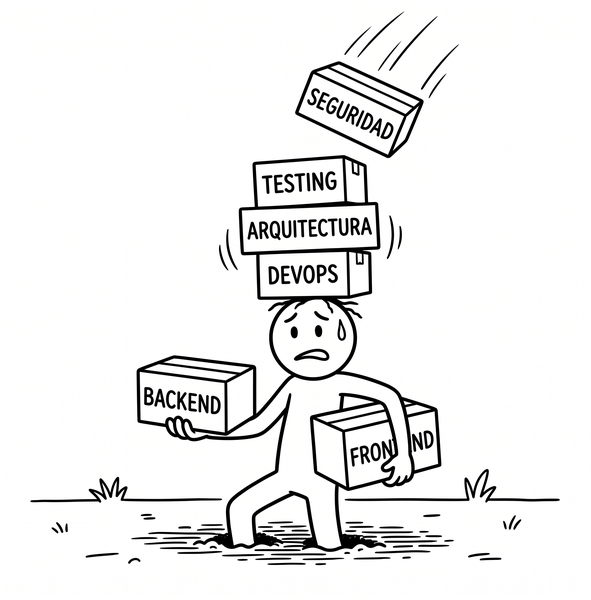
When you assign front-end, back-end, databases, CI/CD, some cloud, security, performance, and “basic” testing to a single person, what you get isn’t a superhero. What you get is someone who copies architectures from blog posts and conference talks without time to truly understand them, who treats databases like Excel spreadsheets with random indexes, who applies “security best practices” by running through superficial checklists with no real threat strategy behind them, and who leaves tests for “when there’s more time” or shrinks them down to bare-minimum unit tests with no real coverage of critical paths.
Companies that don’t treat software quality as central already suffer from frequent bugs, rework, repeated failures, audit problems, poor change traceability, and lost customer trust. If you also rely on “a full-stack developer will get to that eventually,” you’re institutionalizing technical debt .
Even worse: when nobody on the team has real depth in QA, security, or performance, those dimensions become invisible until something serious happens. And when it does, the response is usually “quick patch, we’ll improve it later” — which is the “I’ll quit smoking tomorrow” of software development.
So when people say full-stack usually means “shallow depth and gaping blind spots,” that’s not an exaggeration — it’s the logical outcome of spreading too many responsibilities across one person or a group of surface-level generalists.
Mental health: being “the one who touches everything” isn’t a superpower — it’s a recipe for burning out
In full-stack developer testimonials , especially in tech communities, the same picture keeps coming up: people burnt out from constantly jumping between tasks and contexts.
Developers who share their full-stack experience describe workdays that go from fixing front-end bugs to fighting production fires, tweaking pipelines, investigating slow queries, or helping with “that thing nobody else understands in the system.”
The dominant feeling is that their role is “a joke and a living hell” at the same time — with unrealistic expectations and disproportionate responsibility.
That translates into constant cognitive overload, a permanent impostor feeling (“if I’m full-stack, I should know this too”), and a difficulty switching off that goes beyond normal work stress: if you’re “the one who knows the whole stack,” the idea of something breaking without you around gives you vertigo.
Meanwhile, that suffering gets normalized as a “sign of commitment” or “the modern developer syndrome of being everywhere at once.”
At the same time, best-practice articles remind us that in an already high-pressure environment (deployments, hotfixes, deadlines), what you need is calm and clear thinking — not scratching away at ten fronts with your brain completely fried.
When the role is poorly designed and poorly compensated, “full-stack pride” is just the friendly way to describe what other industries simply call burnout .
Companies: stop using “full-stack” as an organizational weapon of mass destruction
Let’s get back to the companies — they’ve got plenty to answer for here.
When you use “full-stack” to ask one person to cover front-end, back-end, API design, some cloud, some DevOps, some quality assurance, and input on technical decisions, what you’re actually saying is: we don’t want to invest in structure.
Companies that actually take quality seriously separate QA as its own discipline, with professionals who design testing strategies, automation, and acceptance criteria; assign clear ownership of architecture, performance, and security to people who have time to go deep; and treat specialization as an investment, not a “dispensable expense.”
The ones that don’t — but fill their job listings with “full-stack” — are betting, maybe without admitting it, on the “just have someone figure it out” model.
When something goes wrong, the blame falls on the individual (“they weren’t senior enough”), not on the toxic role design that expected one person to function as an entire team.
And yes, some people say it outright: the “full stack developer” as a collective con to cut salary costs — shared fiction where the all-terrain figure gets promoted so companies don’t have to pay what surrounding themselves with specialists actually costs.
Developers: how to stop helping build your own trap
Here’s the practical part that affects you directly. If you know the term has been hijacked, handle it with care.
Define what “full-stack” means in your specific case. If you’re going to use the label, always pair it with a clear explanation: “I’m comfortable working across front-end and back-end with X and Y, and I have working knowledge of CI/CD and cloud, but my focus is Z.” That protects you from being handed responsibilities in areas you’ve barely touched.
Scrutinize job listings with a critical eye — and a sharp nose for BS. When you see a “full-stack” listing on a general job board, ask yourself: are they asking for front-end, back-end, DevOps, cloud, QA, and leadership — for the price of one single profile? Does the salary range add up given the number of fronts they want covered? If the answer is “not a chance,” file it for what it is: a toxic listing (or a garbage one, if you prefer).
Choose one or two axes of depth. A solid career strategy — one backed by serious analysis of generalization vs. specialization in software — is having a broad base but one or two areas where you have real depth. For example: back-end and architecture; front-end and accessibility; data and reliability; QA and automation. Wanting to be “pretty good at everything” is the recipe for permanent mediocrity.
Don’t let your ego be used against you. When someone sells the “full-stack profile” as morally superior to everything else (“we don’t put ourselves in boxes here”), translate: “we don’t want to pay for specialists and we’re not ready to admit we can’t organize a team.” Don’t let anyone convince you that being a specialist means selling yourself short — most of the time it’s exactly the opposite.
Learn to say no. If your current role has been quietly inflating and you’re now acting as developer, architect, QA, and DevOps simultaneously, don’t wait for your next anxiety attack to set boundaries. You can frame it around quality: you need focus to do certain things well, and distributing responsibilities is necessary for reliable software.
Take care of your mental health the way you take care of production. If even for a hotfix they tell you to stay calm to avoid making things worse, practice what you preach: a burned-out developer, hyper-responsible for the entire stack, is a ticking time bomb. Asking questions, asking for help, and turning down poorly designed roles isn’t weakness — it’s professional hygiene.
Toward less mythological, more functional teams
The alternative to this full-stack religion exists, and it’s not about building cathedrals of silos: it’s teams that mix reasonable generalists with well-defined specialists.
In many serious analyses of software careers , the recurring message is that the balance between generalization and specialization is what delivers the most value: generalists who connect the dots, specialists who solve deep problems. The combination — not the extreme — is what works.
That means the company accepts that QA, security, performance, data, UX — none of these are “things someone will get to eventually,” but responsibilities with someone’s name on them. That you can move across the stack without that becoming an excuse to turn you into the “multi-purpose resource” nobody protects. And that job titles stop being “ultra-senior all-terrain full-stack” and start being something clear: back-end developer with solid front-end knowledge, front-end developer comfortable with APIs — specifying expectations and actual scope clearly.
It’s not about killing the full-stack concept itself — it’s about knocking it off its throne and stop pretending it’s the pinnacle of a technical career. At best, it’s a phase, or a very specific type of role in contexts where it actually makes sense.
So… is being full-stack actually bad?
No. What’s bad is swallowing the concept whole without thinking.
Being full-stack can be genuinely useful — especially in small products, early-stage startups, or teams that truly value end-to-end perspective and distribute the load fairly. It can be a great phase for exploring the landscape, understanding how the pieces fit together, and from there deciding where you want to dig deep.
What you don’t have to accept is “full-stack” meaning three jobs for one salary, or feeling guilty for not mastering every layer of the system, or having your value measured by how much you cover instead of how well you do what actually matters.
You’re not a worse developer for saying: “I can get around the stack, but my focus is back-end,” or “I can hold my own in back-end, but where I really deliver value is in front-end and user experience.”
That doesn’t make you less professional — it makes you more focused and, in the long run, considerably more valuable.
If there’s one thing worth slowly putting to rest, it’s the religion of full-stack as the pinnacle of a technical career.
It’s not. It’s just one option, with a real cost in time, energy, and mental health.
If you decide to pay that cost, at least do it with your eyes open — not because someone sold you a flashy title and a promise of express seniority.
Sources and references
This isn’t a thesis bibliography: it’s the paper trail of what I read before writing. Some links are worth clicking; others are here so anyone who wants to can check the sources.
- Full-stack developers: unicorns and other mythological creatures - Paradigma Digital. Critical analysis of the full-stack profile in the job market.
- Full-stack listings on Michael Page - Michael Page. Sample of real job listings with responsibility descriptions.
- The all-terrain profile of the full-stack developer - Genbeta. Analysis of the full-stack developer’s actual work.
- Full Stack Developers - Santander Open Academy - Santander. Example of how academies sell the full-stack profile.
- Full Stack Developer: key competencies - CEI. List of expected competencies for the profile.
- The job market demands more full-stack programmers - EI Posgrados. The pro-full-stack demand argument.
- Full-stack programmer: one of the most in-demand professions - Integrate Technology School. Bootcamp view of the market.
- Demystifying full-stack web development - Bootcamps Madrid. A more realistic take on what the profile actually involves.
- Let’s stop pretending: the full-stack developer as a corporate myth - LinkedIn / Erix Systems. The viral post that nails the problem with the term.
- Full-stack listings on InfoJobs - InfoJobs. A leading Spanish job board for analyzing real listings.
- Full-stack developer on LinkedIn Jobs - LinkedIn. Typical listing with a full responsibility breakdown.
- Full-stack on Tecnoempleo - Tecnoempleo. Tech-focused job board with a sample of Spanish listings.
- Full-stack on Glassdoor - Glassdoor. Listings with salary data.
- Full Stack Developer on Indeed - Indeed. Reference for listing volume and types.
- The full-stack myth (video) - YouTube. Video analysis of the role and its implications.
- The full-stack developer profile - Italenters. View from a recruitment consultancy.
- Is it worth going full-stack? - Reddit r/programacion. Thread with real developer testimonials.
- The risks of not having quality software - ShareMe QMS. Real consequences of technical debt and lack of specialization.
- Why you should learn about software quality - LinkedIn Pulse. Defense of quality as a discipline with its own name.
- Specialization vs. generalization in software - Emiliano Schmid. Rigorous analysis of when to specialize and when to generalize.
- Is it worth specializing or being full-stack? - Frogames. Honest comparison of both career strategies.
- My life as a full-stack developer is a joke and a living hell - Reddit r/learnprogramming. First-hand account of full-stack burnout.
- Non-technical tips for being a better developer - Hiberus. Advice on mental health and sustainability in a technical career.