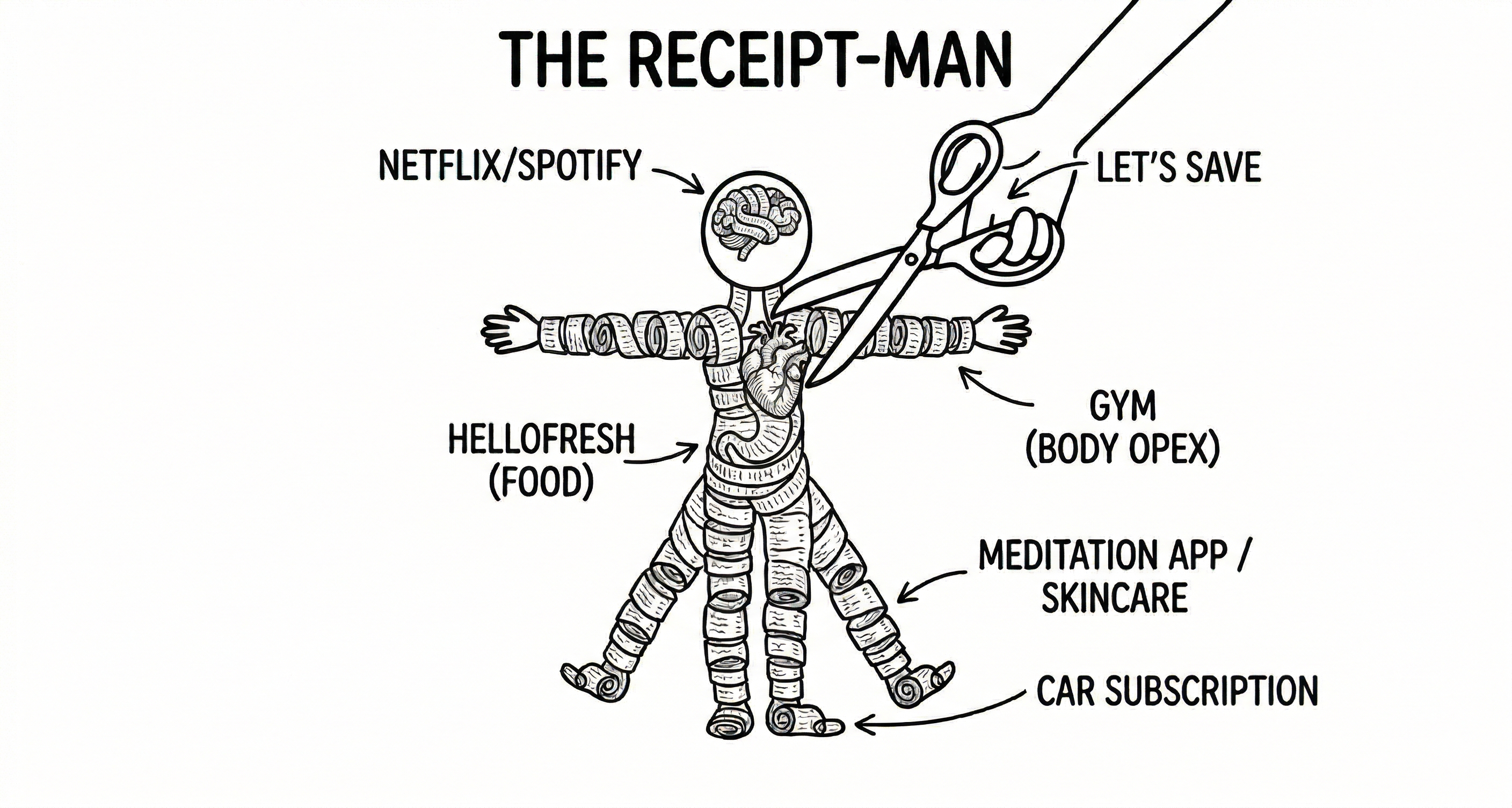
The subscription model sucks
Posted on March 5, 2026 • 13 minutes • 2669 words
Table of contents
- We’ve subscribed to everything, including breathing
- From “pay only for what you use” to “pay for existing”
- BMW and the subscription for a warm butt
- Enshittification: when everything that was convenient slowly degrades into fees and friction
- Regular life turned into a monthly bill
- Now what? Small rebellions and reasonable alternatives
- The model stinks… when we use it for everything
- Quick glossary
- Sources and references
Back in the day, you’d buy a CD, a game, a copy of Word 2003, and that thing was yours “forever” – or at least until you switched computers or your music taste moved on.
Now you blink and discover that everything is a subscription: movies, TV shows, music, the gym, your car, razor blades, cat food, courses, IDEs, design suites, servers… and if you’re not careful, even your couch will hit you with a monthly fee just for sitting near it.
The corporate sales pitch had sounded real smooth for years: “these aren’t expenses, they’re services,” “pay only for what you use,” “it’s the natural shift from CAPEX to OPEX.” It looked great on the PowerPoint. In practice, you’re at the end of the month with your wallet sweating, staring at the list of charges and thinking: “who the hell is this person charging me $7.99 every month since 2021, and why do I keep inviting them?”
Here’s what I’ll cover: subscription fatigue, how we went from renting movies to renting our entire lives, the glorious moment when BMW tried to charge a subscription for having a warm butt, the “enshittification” that Cory Doctorow describes, and what you can do beyond just giving up and crying in front of your bank statement.
We’ve subscribed to everything, including breathing
It started slow, the way everything addictive starts: quietly and without warning. Netflix, Spotify, “look how great this is, one flat fee and I get all of it, amazing.” Then came the SaaS tools, cloud storage, IDEs, CRMs, “premium” newsletters, meditation apps, monthly surprise boxes, courses “for life” (as long as they keep paying for the servers), and even toothbrushes with subscription-based replacement heads.
Researchers have given it a name: subscription fatigue .
The subscription industry has grown roughly 600% in the last decade and is heading toward over a trillion dollars worldwide, but at the same time people are finally pushing back. The average household now carries 10 to 12 subscriptions across streaming, apps, boxes, and software, and people spend around $80-100 a month on things that “auto-renew.” The funny part – or the sad part, depending on how you look at it – is that a significant chunk of those subscriptions people don’t even remember signing up for.
The result is that “subscribe and forget” has mutated into “subscribe and pray you remember what you’re paying for.” And when you do remember, it’s usually at the worst possible time: right when they’ve raised the price again.
From “pay only for what you use” to “pay for existing”
In the IT world, the CAPEX vs OPEX story was sold to us beautifully: stop buying servers and perpetual licenses (CAPEX) and start paying monthly for usage (OPEX) – that was “modernizing.” And hey, it made sense: less upfront investment, more elasticity, a better fit for projects that scale up and down.
The problem is that this logic has spread like mold. What started as “pay per use for cloud infrastructure” has ended up as “monthly fee to use a text editor, to have a high-res logo, or to unlock dark mode.”
In companies, things look a lot like what you see in your personal account, but with more zeros. Each department has been signing up for its favorite SaaS, each team has its five “essential” tools, and when you add it all up you discover there are 300 different applications in the company… and nobody really knows who uses what.
And what was bound to happen eventually did: companies that had piled up nearly 400 SaaS apps on average are slashing hard, cutting their catalog by around 40%, simply because there’s neither budget nor mental bandwidth for that many recurring fees.
Meanwhile, at home you’re doing the same thing on a smaller scale: dropping video platform subscriptions, switching to ad-supported plans, sharing accounts “within the same household, loosely defined,” and firing up the torrent client again “for academic purposes.”
BMW and the subscription for a warm butt
The moment all of this went from “how annoying” to “you’ve completely lost it” was probably when BMW decided to charge a subscription for heated seats .
Here’s the kicker: the car already came with the hardware installed (the heating elements were right there, ready to warm your behind), but if you wanted to actually use them, you had to pay a monthly fee to “activate” the feature. Renting heat, literally.
The backlash was as massive as it was predictable: angry customers, mocking headlines (“pay to not freeze in the luxury car you’ve already paid for”), forums on fire, and a widespread feeling of being double-dipped. The move backfired so badly that BMW had to publicly backtrack : they admitted the seat subscription was “probably not the best idea” and decided to stop charging monthly for hardware already installed.
But make no mistake: they haven’t given up on the subscription model, not by a long shot. They’ve simply understood that there’s a line people aren’t willing to cross: paying rent on something physical you’ve already bought. Subscriptions will stick around for software, connected services , driving aids… but your butt, for now, goes back to the traditional “pay once and you’re done” model.
Enshittification: when everything that was convenient slowly degrades into fees and friction
Author and activist Cory Doctorow recently coined a term for a phenomenon we all sensed: enshittification , the process by which platforms and services that start out great gradually degrade until they become almost insulting.
His framework, simplified, goes like this:
- Phase 1: “Come on in, this is wonderful.” The platform delivers tons of value to users to grow: low prices, few restrictions, great experience.
- Phase 2: “Time to actually make money.” Changes start favoring paying customers, advertisers, and suppliers: more ads, less control, more friction for anyone who doesn’t pay up.
- Phase 3: “Everyone’s a hostage now.” When both users and businesses depend so heavily on the service that they can’t easily leave, the platform squeezes both: raises prices, cuts features, locks exits (trapped data, DRM, proprietary formats).
Subscriptions fit perfectly here: they’re the ideal tool to make Phase 3 wildly profitable. Once you’ve got people “hooked” on a service (because that’s where their photos, documents, playlists, projects, and their pr0n live), it’s enormously tempting to keep nudging the fee up, slicing features into “premium” tiers, shoving ads where there were none… because you know walking away is a pain.
It’s not a conspiracy, it’s gold-rush math: when locking a user into a monthly fee is cheaper than actually taking care of them, quality drops.
Regular life turned into a monthly bill
You don’t have to be a cloud nerd to notice the shift. Just look at any given month: video and music platforms, phone photo storage, “pro” productivity apps so you can sync across more than two devices, the gym, workout apps, meditation apps because the gym is depressing you, cars with connected services and “over the air” updates… Even insurance and healthcare that, in some countries, practically work like a subscription just to pay the “fair price” for things.
The mental load isn’t just financial – it’s also logistical: remembering what’s where, what happens if you cancel, what you lose if you unsubscribe. Everything we’re seeing about consumer behavior in 2026 backs this up: people feel they no longer buy products but temporary usage rights that need to be renewed while their income (oh, surprise) stays the same.
And look, it’s not all evil: sometimes the model makes sense (services that require servers, updated data, ongoing support). But when you see subscriptions just to use basic features on a device you’ve already paid for, the feeling of being ripped off is hard to shake.
Now what? Small rebellions and reasonable alternatives
Since this isn’t going away tomorrow, the question is how to live with the subscription model without it eating your bank account and your sanity.
We still have a few lines of defense, somewhere between boycott and pragmatism.
1. Brutal inventory: list everything that charges you each month
Sounds boring, but it’s liberating. A sit-down with your bank statement or credit card and a strong coffee:
- Write down every subscription, big and small.
- Mark which ones you actually use and which are zombies.
- Calculate the monthly and yearly total.
That alone has gotten people to ditch a bunch of stuff that was just sitting there “out of inertia.” It’s your personal “Great Unsubscribe .”
2. Selective boycott: don’t pay rent on things that should be a purchase
BMW taught us something: complaining actually works sometimes. The avalanche of criticism was so brutal they had to reverse course on hardware subscriptions. That sends a message to the rest of the industry: there are red lines, and if you cross them, you get a reputational slap in the face.
You can apply this philosophy to your daily life: avoid gadgets that require a subscription to unlock basic local features, prefer apps and tools that offer a one-time purchase or perpetual license when it makes sense, and explicitly say “no” to anything that smells like renting something that doesn’t depend on servers or external data.
Sure, you’re not going to take down a Fortune 500 company single-handedly, but you can be part of the signal that makes products like subscription butt-warmers die in ridicule.
3. Go back to buying some things “the old way”
In software, the perpetual license is making a comeback in specific niches: tools you pay for once, with minor updates included, and if you want to jump to the next major version, you pay a reasonable upgrade fee. It’s not perfect, but it’s a compromise that many people find mentally healthier than yet another automatic charge.
A personal example: DaVinci Resolve, the video editor by Blackmagic Design. The free version is already absurdly complete, and the Studio version is a one-time purchase (ONE time) that includes all future updates, no expiration date, no tricks. While Adobe Premiere charges you month after month and hands out crashes like free samples at Costco, Resolve gives you an actually professional product, stable, with color grading tools used in Hollywood. I’ve been using it for years and the experience has been so good that I’m actually eyeing their pro hardware now. That’s what happens when a company earns your trust instead of locking you into a fee: you feel like giving them more money voluntarily.
For content, the equivalent is buying books (in print or DRM-free digital) instead of relying solely on catalogs that can rotate, buying music you truly care about knowing it’ll still be there even if a service pulls it, and downloading backups of your own stuff instead of blindly trusting “it’ll always be in the cloud.”
It’s not about hoarding like the digital apocalypse is coming, but about not putting all your eggs in the “renew” basket.
4. Share, rotate, pause
A strategy that half the world already uses is rotating subscriptions: one month you have one video platform, the next month a different one, instead of paying for all of them at once “just in case.” Many now offer pause options without losing your account, because they’ve seen the writing on the wall.
Sharing within what the terms allow (family, household, etc.) – or slightly beyond – is also a way to cut the bill without abandoning the model. It’s not a revolution, but every small adjustment counts.
5. The elephant in the room: piracy is back (and they brought it)
There’s something the industry prefers not to say out loud: after years of bragging that streaming had “killed” piracy, it turns out piracy has come back stronger than ever. And it hasn’t returned because people are bad – it’s back because the industry pushed them back to it.
When Netflix had almost everything for a reasonable fee, pirating was more hassle than paying. Now, with every studio setting up its own little shop, content fragmented across eight different platforms, exclusives that last only a month, and prices going up every quarter, torrenting is the most convenient option again. Sad, but real.
This isn’t a defense of piracy, mind you. It’s the logical consequence of squeezing too hard: if you make paying more inconvenient than not paying, don’t be surprised when people stop paying.
The model stinks… when we use it for everything
The subscription model isn’t garbage by definition. It has clear advantages where there are ongoing costs (servers, support, real-time data), variable usage that scales up and down, or a need for frequent updates.
The problem is when all you have is a hammer, and everything starts looking like a nail. When instead of asking “what makes sense as a service?” the question becomes “what else can we put on a monthly plan to please shareholders?” That’s where it starts to smell, and not like a heated seat.
We’re not going back to a world where everything came in a box with a manual inside. But we are seeing users get fed up and cancel more, companies slashing SaaS like someone on an aggressive post-holiday diet, and brands backing down when they cross certain lines – like BMW with their seats.
Between giving up and setting fire to all your accounts, there’s a pretty decent middle ground: knowing what’s worth renting and what’s worth buying again. And above all, remembering that the “cancel” button exists and is more powerful than it looks when enough of us press it at the same time.
Meanwhile, we’ll keep watching someone try to charge us a subscription for the air fryer and the AI mirror that critiques your skin.
Laughing about it, at least, is still free.
For now.
Quick glossary
A quick-and-dirty glossary so you don’t have to pay yet another subscription to a tech dictionary.
- CAPEX (Capital Expenditure): capital spending – the upfront investment in assets like servers, perpetual licenses, or equipment. You pay once and depreciate it over time.
- OPEX (Operational Expenditure): recurring operational spending. Instead of buying, you pay a periodic fee to use something. Subscriptions are pure OPEX.
- SaaS (Software as a Service): software you don’t install on your machine but use over the internet via a subscription. Gmail, Slack, Notion, Figma… pretty much everything that lives in the browser.
- DRM (Digital Rights Management): technology that controls what you can do with digital content you “buy.” It’s what stops you from copying an ebook or sharing a downloaded movie. It’s also what makes you lose access if you stop paying.
Sources and references
If you want to dig deeper into the topic – or just verify we weren’t exaggerating about BMW and the warm butt.
- Subscription fatigue - Shortform. Overview of subscription fatigue with average spending data and trends.
- Consumer behaviour in the digital age - European Business Review. Analysis of consumer behavior amid subscription overload.
- The breaking point of subscription fatigue - Accedo. Data on the breaking point of video subscription fatigue.
- Video subscription fatigue drives streamers to cancel - CivicScience. Study on the cancellation and rotation of streaming platforms.
- BMW drops heated seats subscription - Forbes. BMW drops the heated seat subscription.
- BMW stops subscription for heated seats - CarScoops. The massive backlash against BMW.
- BMW admits heated seats subscription was a mistake - Autoblog. BMW publicly admits the mistake.
- BMW admits heated seat subscriptions were a mistake - Drive. Australian coverage of the BMW case.
- BMW relents on heated seat subscription - Edmunds. BMW caves to consumer pressure.
- BMW commits to subscriptions after heated seat debacle - The Drive. BMW keeps software subscriptions but drops hardware ones.
- Cory Doctorow: enshittification - GDI. Description of the enshittification concept and platform degradation.
- The age of enshittification - The New Yorker. Article on the age of enshittification.
- Enshittification in healthcare - Reddit r/medicine. Thread on applying the concept to healthcare.
- BMW giving up on heated seat subscriptions - Reddit r/cars. Discussion on BMW’s reversal.
- BMW heated seat subscriptions discussion - Reddit r/technology. Technical debate on subscriptions for physical products.