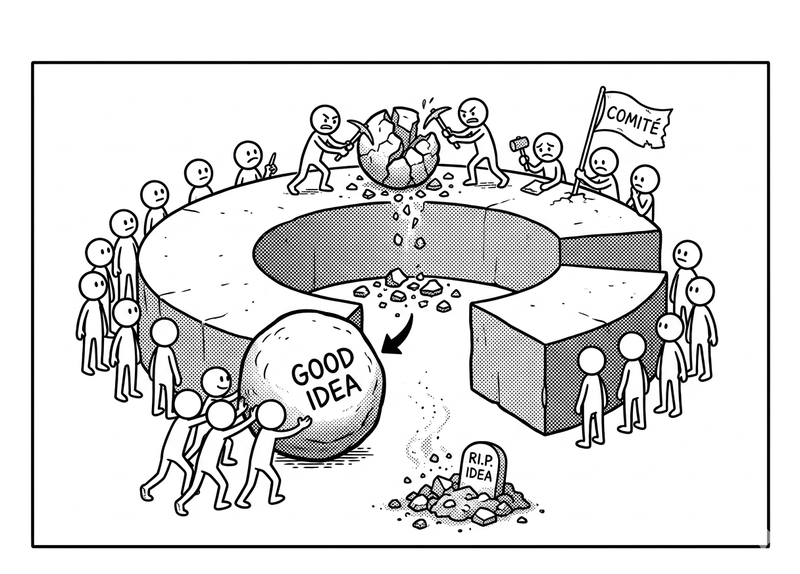
The Committee: Where Good Ideas Go to Die Slowly
Posted on May 11, 2026 • 17 minutes • 3469 words
Table of contents
- The Illusion of Smart Consensus
- More Heads Don’t Always Think Better
- The Committee as a Responsibility-Dilution Machine
- When Consensus Isn’t Seeking Truth, But Social Peace
- The Mirage of the “No-Boss” Company
- The Real Cost of All That Participatory Liturgy
- Hold On: Sometimes the Group Actually Helps
- The Sensible Move Isn’t to Abolish the Group — It’s to Tame It
- Conclusions (More or Less)
- Quick glossary
- Sources and references
Some business concepts age poorly, yet keep getting sold with the same enthusiasm a snake oil peddler uses to fleece unsuspecting customers.
One of those concepts is “everyone decides together” — that corporate liturgy where the apparent absence of hierarchy automatically equals collective intelligence, organizational maturity, and workplace happiness.
Sounds wonderful.
You’re almost tempted to add piano music, shots of people smiling in a glass-walled conference room, and a deep voice talking about “active listening,” “distributed leadership,” and “collaborative ecosystems.”
Then you walk into the actual room and discover it’s not Athens — it’s a procession of slide decks, unsolicited opinions, and clocks dying in silence.
The fantasy of the democratic company has something deeply seductive about it. Nobody wants incompetent bosses, nobody wants authoritarianism, and almost nobody disputes that listening to people who actually know something about a topic is usually a good idea.
So far, so good.
The Illusion of Smart Consensus
The problem starts when “listening” turns into “everyone decides everything,” and “giving people a voice” evolves into “submitting every decision to an endless assembly where seven people weigh in who haven’t touched the problem with a ten-foot pole.”
At that point, management stops resembling a discipline and starts looking more like a homeowners’ association arguing about paint colors at eleven o’clock at night.
What’s interesting is that this isn’t just a rant from someone burned by too many meetings with bad vending machine coffee. Scientific literature and organizational research have spent decades studying group decision-making — its real benefits, its recurring pitfalls, and its costs.
And the picture that emerges isn’t exactly an HR motivational poster.
The evidence shows that groups can work under very specific conditions, but also that they’re especially good at three things: wasting time, diffusing responsibility, and rewarding the most comfortable or socially dominant opinion over the most correct one.
And yes, the suspicion that many committee decisions are essentially an inefficiency factory with snacks is fairly well-founded. The bad news for consensus enthusiasts is that the data isn’t particularly romantic.
The good news, in fairness, is that the data doesn’t justify the cult of the lone genius who makes decisions on a cocktail napkin either.
As is almost always the case in management, the devil is in the process design. And the problem is that many companies invoke collective intelligence when they’re actually organizing a generic-brand cognitive traffic jam.
More Heads Don’t Always Think Better
Getting several people together around a problem improves the odds of getting it right. So they say. Sometimes that’s true. But that “sometimes” comes with fine print — and not in Arial 11, either.
The famous wisdom of crowds has some empirical support, but only under fairly demanding conditions: genuine diversity of perspectives, independence of judgment, and some degree of useful knowledge on the part of participants. Without those conditions, the crowd doesn’t become wise — it just becomes a crowd, which is punishment enough.
That’s the first blow to corporate mythology. Collective intelligence doesn’t magically appear the moment you put eight people in a conference room and project a slide titled “participatory dynamics.”
If group members think alike, are hierarchically dependent on each other, or arrive already shaped by the opinion of the most senior person in the room, what you get isn’t aggregated intelligence — it’s social alignment.
And that, however elegant it looks in the annual report photo shoot, doesn’t do much for solving complex problems .
Classic experimental research is fairly brutal on unchecked optimism. A widely cited 1984 study concluded that groups tend to outperform the average of their individual members, but not the best individual available.
Put bluntly: if you have someone in the group who genuinely knows what they’re talking about, the committee as a whole doesn’t necessarily improve on their judgment — it often drags it down to something mediocre, comfortable, and defensible.
Excellence, in the committee’s hands, tends to go through a social spin cycle.
And here’s an uncomfortable truth for certain modern takes on horizontal leadership: adding people doesn’t automatically add useful knowledge. It often adds noise, coordination costs, and a very human tendency to confuse participation with quality — as if a decision were better for having passed through more mouths.
By that logic, a talk show panel would design a better car than an engineering team. And, unsurprisingly, nobody wants to ride in that car.
The Committee as a Responsibility-Dilution Machine
There’s a reason so many collective decisions end up as soft, ambiguous, or downright stupid solutions: in a large group, responsibility dissolves with almost chemical efficiency. If nobody quite decides, nobody quite gets it wrong. That’s a great advantage for surviving politically and an absolute disaster for producing good outcomes.
The phenomenon has been known for over a century. The Ringelmann effect showed that as group size increases, individual contributions decrease. What started as an experiment measuring people pulling on a rope ended up describing something perfectly recognizable in the modern office: the more participants in a collective task, the easier it is for some to coast, others to talk for the sake of talking, and a few to hide behind everyone else’s effort.
Social psychology calls this social loafing . In less academic terms, it’s the noble art of seat-warming with methodological cover.
This has a devastating effect on decision meetings. When too many people are involved, each person feels less obligation to prepare thoroughly, less need to take a clear position, and less personal cost for being wrong. The group, meanwhile, convinces itself that the work was more rigorous precisely because there were so many people around the table. Which is like assuming a recipe improves by adding more cooks stirring the pot at the same time. You can imagine how it turns out.
On top of this motivational deterioration comes the coordination cost. More people means more communication channels, more redundant explanations, more context to repeat, and more opportunities for the conversation to veer off the highway entirely. It’s no coincidence that many high-performance tech organizations actively avoid large groups for decision-making.
Amazon’s two-pizza rule starts exactly there: small teams, clear accountability, and as little bureaucracy as possible.
Nobody invents those rules for fun; they get invented because someone has already sat through enough fifteen-person meetings to understand that collaboration, without boundaries, becomes a form of polite sabotage.
When Consensus Isn’t Seeking Truth, But Social Peace
There’s another particularly pernicious trap in committee decisions: confusing consensus with quality.
It sounds reasonable to want everyone aligned. The problem is that alignment is a social property, not an epistemological one. A group can be perfectly aligned while marching with admirable discipline toward a cliff.
Irving Janis turned this into a famous concept with the term groupthink : a mode of thinking where the desire for unanimity outweighs the realistic evaluation of alternatives.
The theory has faced criticism , and not everything in it is validated with the rigor that some pop management books suggest. But as a description of an organizational pattern, it remains unsettlingly useful.
Cohesive groups, under pressure to decide, with dominant leadership and little room for dissent, tend to censor the uncomfortable, rationalize the questionable, and treat disagreement as a threat to group harmony rather than a possible lifeline.
The Challenger case remains a monumental example of this pathology. There were serious technical warnings about the O-rings’ behavior at low temperatures, but institutional pressure and collective inertia overrode engineering judgment.
The group achieved what a badly designed group does best: turning a well-founded technical concern into a social inconvenience. Nobody wants to be the person who kills the launch, especially when everyone else in the room is already emotionally committed to moving forward. The result was historic, yes — just not in the way anyone would have wanted.
In less tragic form, this happens every week in ordinary companies. The committee isn’t after the best decision — it’s after the least controversial one. The one that doesn’t upset anyone. The one that fits on a slide. The one that doesn’t force anyone to say “that idea you proposed doesn’t work.”
And since the truth has the bad habit of being rough, specific, and sometimes unpleasant, it tends to lose out to the institutionally safer alternative: a consensual mediocrity that lets everyone leave the room feeling good about themselves.
The Mirage of the “No-Boss” Company
Every so often, the same puff piece resurfaces with a new haircut: young people who don’t want to be managers, flat organizations, decision circles, distributed autonomy, distributed leadership, all that.
It’s presented as liberation from the old hierarchy, almost as if the classic org chart were an industrial relic and the future belonged to the permanent assembly with couches and colorful sticky notes. Then come the unpleasant details, like actually running things day to day.
Zappos’s experience with holacracy is one of the most studied cases of this illusion. The system promised a more flexible, self-managed, and less hierarchical company. What appeared instead was something else: operational complexity, role confusion, coordination overload, and a fair number of employees wondering whether that was an organization or an administrative obstacle course.
When a voluntary buyout was offered to those who didn’t want to continue under that model, around 18% of the staff took it .
Very empowering, except for the minor detail that a notable share of people preferred to take the money and leave rather than keep navigating that organizational architecture.
The problem with these utopias isn’t that hierarchy disappears. If only it were that simple. The problem is that it doesn’t disappear — it just goes underground.
Jo Freeman explained this decades ago when discussing supposedly structureless collectives: the absence of formal structure typically conceals informal leadership that is unacknowledged and less accountable.
Translated to the modern office, that means if you don’t clearly name who decides, someone will still decide — only now they’ll do it without visible accountability, often with more arbitrariness and a quasi-mystical aura of “natural influence.” In other words, a hierarchy, but a cowardly one.
That’s why “democratic” companies tend to produce a delicious paradox. They preach decision-making equality while consolidating opaque power relationships. Officially, everything is decided together. In practice, the decision goes to whoever dominates the room, controls the narrative, has the best relationship with leadership, or simply outlasts everyone else in meetings.
It’s the old command-and-control, but in a linen shirt (the fabric, not me) talking about collaborative culture.
The Real Cost of All That Participatory Liturgy
If all of this were just a philosophical question, it would almost be charming. The problem is that decision-making inefficiency costs money, time, and focus. A lot of money, a lot of time, and an enormous amount of focus. McKinsey estimated that executives spend an average of 37% of their time making decisions, and that 61% of that time is poorly spent.
The estimate for a typical Fortune 500 company is obscene in the worst sense of the word: more than 530,000 wasted working days per year and around $250 million in salary costs tied to inefficient decision-making processes.
The figure is worth a second look, because it does a pretty good job of dismantling the narrative that “deciding together” always improves quality.
Sometimes what improves is the volume of ceremonial activity. Meetings get called, agendas get aligned, sensitivities get collected, viewpoints get documented, and an impeccable choreography of participation gets assembled.
Meanwhile, the actual problem is still there, probably getting worse — like those bugs nobody fixes because first you have to reach consensus on the bug taxonomy, the bug governance framework, and the emotional coexistence guidelines for the bug.
Committee inefficiency has a less visible but equally corrosive cost: it kills the initiative of the people who actually know what they’re doing.
If every technical decision ends up subjected to a cluster of generalists, political sensitivities, and observers with no operational responsibility, experts learn a very simple lesson: thinking well doesn’t pay off. It’s more profitable to defend something with good rhetoric, confident gestures, and exactly the right tone of smiling assertiveness.
And when an organization’s deep expertise consistently loses to social performance, you no longer have a company — you have an American Idol audition.
Hold On: Sometimes the Group Actually Helps
It would be easy to wrap this up with a total condemnation of collective decision-making, but that wouldn’t square with the evidence. Much as it pains me, the data doesn’t support all of my claims.
The literature shows that groups can add value under certain conditions, especially when they aggregate diverse information and the process is carefully structured. The nuance matters because it keeps you from falling into the opposite caricature — the lone genius who always sees further than everyone else. The lone genius also gets it wrong, sometimes with frightening efficiency .
The key is in the design.
Methods like the Nominal Group Technique or Delphi work better than traditional open discussion because they force individual thinking first, and only then compare ideas. That detail seems minor, but it isn’t.
When a person formulates their judgment before hearing the group, they reduce social contamination. When everyone opines already influenced by the dominant tone in the room, the supposed deliberation becomes a negotiation around an idea that perhaps nobody would have chosen independently .
It also helps when the problem is the right kind. Groups can perform well when the task requires piecing together scattered information, stress-testing risks, or incorporating perspectives that genuinely don’t fit inside a single head.
But that requires genuine diversity, independence, a contained size, and a clear mechanism for closing the decision . In other words, it requires exactly the opposite of the typical meeting where twelve people show up because they were “involved,” even though several of them are only involved in the spiritual sense of the word.
In other words, the group isn’t useless by definition. What tends to be useless is the improvised committee, the unstructured conversation, and the cult of consensus as if it were a virtue in itself.
Good collaboration exists. It just doesn’t look much like the collaboration sold in corporate videos with people walking in slow motion down a sunlit hallway.
The Sensible Move Isn’t to Abolish the Group — It’s to Tame It
The classic mistake is framing the question as a war between hierarchy and democracy, between bosses and happy tribes, between vertical command and collective intelligence. It’s a false dichotomy.
The right question isn’t whether one person or a group decides. The right question is who contributes information, who deliberates, who decides, and how accountability is made visible.
Organizations that make better decisions tend to solve this with a combination that’s deeply unspectacular and highly effective: listen to several people, discuss with structure, limit group size, and assign a clear decision-maker. No magic. No utopia. Just process design , which is considerably less sexy in a promotional video but infinitely more useful when you actually need to resolve something.
That’s why the problem with many companies isn’t the committee in the abstract — it’s their favorite way of corrupting it.
They invite too many people, mix expert knowledge with decorative opinions, confuse political legitimacy with technical quality, and drag out the conversation until fatigue replaces judgment.
In the end, the best idea doesn’t win. The idea that survives wins. And surviving a committee isn’t always a sign of excellence — it’s often a sign that the idea was bland enough, vague enough, or agreeable enough not to trigger anyone’s defenses.
Conclusions (More or Less)
The available evidence makes it clear that committee-based decision-making is, in general, an overrated tool. It can work, yes — but not because the group has some kind of intrinsic moral virtue, but because the conditions have been created for diversity to add value without being crushed by social pressure, bureaucracy, or hierarchical ego.
That doesn’t mean defending corporate strongman leadership or worshipping the lone genius who dictates strategy on a cocktail napkin. It means, rather, stopping the practice of selling as sophistication what is often nothing more than fear of deciding.
Because a non-trivial share of the enthusiasm for consensus comes from exactly that: the political comfort of spreading responsibility until it becomes unrecognizable. If the decision goes wrong, it belongs to everyone. And if it belongs to everyone, it belongs to no one. The dream of any organization that runs from accountability.
Listening to several people is healthy. Requesting technical pushback is sensible. Designing mechanisms to avoid biases and errors is non-negotiable. But turning every decision into a deliberative pilgrimage isn’t organizational maturity — it’s a very expensive way to fake collective intelligence.
The committee has its place, of course. Just like a fire extinguisher in a kitchen.
But you wouldn’t use a fire extinguisher to cook, would you?
Quick glossary
Not everyone has survived enough committees to learn the vocabulary.
- Wisdom of crowds: the phenomenon by which the aggregated estimates of many independent individuals can outperform those of a single expert — provided there’s genuine diversity of judgment and no mutual influence. Without those conditions, the crowd is just expensive noise.
- Social loafing: the tendency to reduce individual effort when working in a group, because responsibility gets diluted. The more people on a task, the easier it is to hide behind everyone else’s work.
- Groupthink: a dynamic in which group cohesion and pressure for consensus suppress critical analysis. The group decides — but what it decides is the least controversial option, not the most correct one.
- Ringelmann effect: as group size grows, each member’s individual contribution decreases. Originally measured by having people pull on a rope; perfectly recognizable in any meeting room with more than six people.
- Nominal Group Technique: a structured decision method in which each participant writes down their judgment individually before group discussion. Reduces social contamination and the bias toward whoever is loudest or most senior.
- Holacracy: an organizational model that eliminates formal hierarchy in favor of self-organized circles of roles. In practice, it tends to replace visible hierarchy with an informal, less recognizable one that carries even less accountability.
Sources and references
Because “I read it somewhere” isn’t the same as actually reading it — but at least here are the originals to check for yourself.
- Lorge et al. (1984): group vs. individual performance - Organizational Behavior and Human Performance. The classic study showing that groups outperform the individual average but rarely the best individual member.
- Ringelmann effect - Wikipedia. The phenomenon describing how individual effort decreases as group size grows.
- Three Keys to Better Decision Making - McKinsey. Summary of the report on decision-making efficiency in large organizations.
- Wisdom of the Crowd - Wikipedia. The concept and the conditions under which collective intelligence actually works.
- Wisdom of Crowds (Investopedia) - Investopedia. An applied explanation of the concept with examples.
- Collective Intelligence in Organizations - FUELS Working Paper. On the real conditions for collective intelligence and its limits.
- Group Decision Making - LibreTexts Social Psychology. Academic overview of group decision-making processes.
- Social Loafing - Simply Psychology. Explanation of the social loafing phenomenon in groups.
- Amazon Two-Pizza Team - AWS Executive Insights. The origin and rationale behind Amazon’s small-team rule.
- What Enterprises Can Learn from the Two-Pizza Rule - ISHIR. Practical application of the small-team philosophy.
- Groupthink (EBSCO) - EBSCO Research Starters. Academic introduction to Janis’s groupthink concept.
- Groupthink - Wikipedia. Reference article on groupthink and its manifestations.
- Groupthink: A Monument to Truthiness - British Psychological Society. Academic critique of groupthink’s empirical foundation.
- Janis (1982): Groupthink original paper - APA PsycNet. Irving Janis’s foundational paper on groupthink.
- Groupthink and the Challenger Disaster - Penn State. Analysis of groupthink’s role in the Challenger tragedy.
- The Challenger Case: Organizational Failure - Quest Journals. Study of the organizational failure behind the Challenger disaster.
- Zappos and Holacracy (Fortune) - Fortune. In-depth report on Zappos’s holacracy experiment.
- Zappos Holacracy: What Went Wrong - SI Labs. Analysis of the dysfunctions of the holacratic model at Zappos.
- Why Holacracy is Crashing at Zappos - LinkedIn/Matthew Larsen-Morava. Critical perspective on the collapse of the experiment.
- Why Flat Organizational Structures Fail - Lighthouse. On hidden hierarchies in supposedly flat organizations; includes Jo Freeman’s perspective.
- Decision Making in the Age of Urgency - McKinsey. Full report on decision-making efficiency and costs in large companies.
- When Can Groups Beat Individuals? - PubMed Central. Study on the conditions under which groups outperform individuals.
- Group vs. Individual Decision Quality - PubMed Central. Comparative meta-analysis of decision quality between groups and individuals.
- Group Decision Making and Effectiveness - Academy of Management. Review of structured methods for improving collective decision-making.
- Nominal Group Technique - PubMed Central. Description and effectiveness of the Nominal Group Technique versus free discussion.
- Diversity and Group Performance - PubMed Central. On diversity of perspectives as a condition for collective intelligence.