The False Consensus: When Nobody Dares Say the Idea Is Bad
Posted on June 15, 2026 • 13 minutes • 2663 words
Table of contents
- The Meeting Where Everyone Understands the Problem and No One Says a Word
- The Big Misunderstanding: Mistaking Harmony for Collective Intelligence
- The Profitable Silence
- Groupthink With Better Packaging
- The Bad Idea Nobody Wanted to Upset
- Psychological Safety Isn’t About “Good Vibes” — It’s About Tolerating Discomfort
- The Leader Who Asks “Any Objections?” and Kills Every Objection
- How the Truth-Teller Gets Punished
- Healthy Conflict, That Mythical Beast
- The Mediocre Idea as a Group Product
- What It Would Take to Break the Spell
- Sources and references
There’s a corporate scene that fascinates me precisely because it’s so perfectly ridiculous.
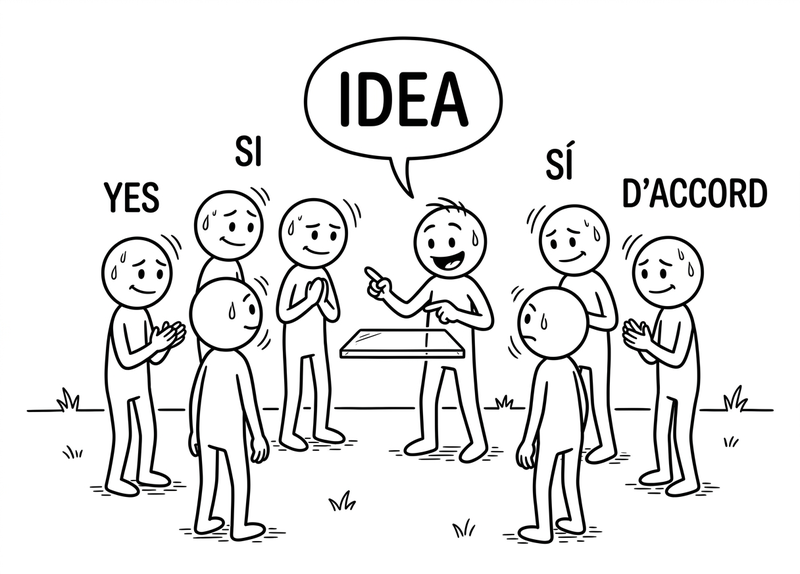
Someone presents an idea that’s weak, half-baked, clearly in need of work.
While they talk, you watch half the room mentally tear it apart in real time. Someone thinks, “this doesn’t scale.” Someone else, “this breaks half the system.” Someone else, “business asked for this without talking to anyone.”
And yet, when it’s time to weigh in, what comes out of the room is a chorus of heads nodding along with that “yeah, yeah, makes sense, let’s move on” look.
And that’s how false consensus is born: that wonderful collective production where nobody truly believes in the idea, but nobody wants to be the first to say it’s bad either.
The Meeting Where Everyone Understands the Problem and No One Says a Word
Let me walk you through a typical meeting, because we’ve all been in this one.
Monday, 10 a.m. Conference room or video call, doesn’t matter; the theater works in both formats.
There’s a new product, a strategic initiative, a partner integration, an architecture redesign, whatever you like.
Someone with authority presents the plan with conviction. Not necessarily because the plan is good, but because it comes blessed by power, which is not exactly the same thing.
While they talk, you hear very little. The occasional “mmm.” The occasional “yeah, interesting.” Nobody interrupts to say, “sorry, but this is based on a wrong premise.” Nobody asks if anything’s been validated. Nobody points out that half the complexity comes from a requirement that might not even exist.
And it’s not that people don’t see it. They do. Long before it blows up in production, gets delayed three months, or ends up costing twice what was planned.
The real problem is different: speaking up has a cost. Staying quiet, on the surface, doesn’t.
That cost can be small (coming across as a nag, looking out of step) or considerably bigger (getting labeled “difficult,” “negative,” or “not a team player”).
In many companies, especially the ones that love to brag about their “great vibe,” healthy conflict is so demonized that saying “I’m not convinced” comes across as practically antisocial.
The Big Misunderstanding: Mistaking Harmony for Collective Intelligence
There’s a widespread lie here. We’ve been sold the idea that mature teams are the ones that “flow,” the ones that coordinate without friction, the ones that walk out of meetings with a quick, clean consensus.
It looks great in slide decks. The problem is that, in serious intellectual work, that picture is usually false.
Amy Edmondson , who has spent years researching this, sums it up beautifully: in a huge number of workplaces, it’s far more common for people to stay quiet out of interpersonal fear than to feel free to speak candidly.
The problem isn’t a lack of ideas. It’s a lack of conditions for sharing them.
Psychological safety, which is the star concept here, doesn’t mean “let’s all love each other” or “anything goes.” It means something much more uncomfortable and useful: that people feel they can ask questions, disagree, flag risks, or admit doubts without fear of being punished or ridiculed. And when that exists, teams learn more, innovate more, and screw up less.
Now, building that is a lot harder than decorating a meeting with smiles, emojis, and “we’re a team” talk. Because the real test isn’t how a good idea gets celebrated. The real test is how the group responds when someone says, “No, not this.”
The Profitable Silence
There’s a deeply human reason why false consensus thrives: staying quiet usually pays off in the short term.
Don’t stand out. Don’t make things complicated. Don’t open a can of worms. Don’t be the one who hits the brakes. Don’t be the killjoy who forces everyone to rethink something right when everyone wants to leave the meeting feeling like progress was made.
And that incentive (perverse and toxic) is rarely written down anywhere, but it’s learned fast.
You learn it when you see the person who points out problems in public later described as “intense.” You learn it when promotions seem to favor whoever doesn’t make too much noise. You learn it when mistakes get punished more harshly than omissions.
Then survival logic kicks in: better not to stand out. Better not to fight every battle. Better to nod along a little and see what happens.
If it goes well, great. If it goes badly, well, the group decided this anyway.
That’s the dirtiest psychological trick of false consensus: it dilutes responsibility. Nobody championed the idea with real conviction, but since nobody truly challenged it either, it ends up looking like everyone was reasonably on board.
It’s a kind of whitewashing through silence.
Groupthink With Better Packaging
What used to be called groupthink (the old “let’s all go along because pushing back is too tiring or too scary”) is still fully operational.
The research on this is old but still spot-on: when a group prioritizes keeping harmony and cohesion over evaluating ideas honestly, what it gets isn’t consensus; it’s an illusion of consensus .
There are definitions I love for how precise they are. One talks about “the false feeling of unanimity” that gets created when people avoid conflict and stop examining alternatives.
Another one sums it up with that perfect phrase: go along to get along . In other words: keep your head down and don’t rock the boat.
The worst part is that from the outside it looks great. The meeting flowed. There was no tension. Everyone seemed aligned. You walk out with an almost indecent sense of efficiency.
Only later, when the problems start, do you discover that “alignment” was just a Hollywood backdrop.
And here’s the truly funny part: a lot of companies celebrate those “friction-free” meetings as a sign of maturity. When in reality, in complex technical environments, a bit of smart friction is usually a sign of health.
If everything goes down too smoothly, be suspicious.
The Bad Idea Nobody Wanted to Upset
There’s a very recognizable pattern in tech. Someone proposes a spectacularly over-engineered architectural solution for a small problem. An event system, three queues, four microservices, and a dash of AI while we’re at it.
Half the room instantly clocks that this is a complexity overdose. But nobody wants to be the person who says, “Sorry, this is overkill for what we’re trying to solve.”
Why? Because the person presenting it has rank. Because they’ve already shown it to leadership. Because the sensible alternative (something simpler, uglier, less flashy) doesn’t look good on a slide. Because cutting down a big idea feels like a personal attack on whoever brought it.
So the discussion shifts to safer ground. Nobody questions whether the idea is good anymore. They talk about side details: whether the queue should be Kafka or RabbitMQ, whether the API should be REST or GraphQL, whether it’s better to roll it out in two phases. They debate decorations around a core problem nobody wants to touch.
It’s a marvel of collective self-deception. It looks exactly like a deep technical conversation, when underneath it all you’re just dancing around the uncomfortable question: “Do we actually need this?”
Psychological Safety Isn’t About “Good Vibes” — It’s About Tolerating Discomfort
It’s worth hammering on this point because it gets misread constantly.
Psychological safety isn’t a soft culture where nobody contradicts anyone and everyone validates each other’s feelings. It’s actually the opposite of that fake “good vibes” atmosphere that keeps you from arguing.
Several recent studies and write-ups keep making the same point: teams with higher psychological safety show better communication, more learning, and more innovation, because people feel authorized to take social risks — that is, to say things that might be uncomfortable.
In a study of 580 employees , psychological safety correlated positively with the ability to generate and share innovative ideas.
Not because people feel happy all the time, but because they can put ideas to the test without fearing that every disagreement will be taken as a personal attack.
That requires a shift many companies can’t stomach: accepting that a good meeting isn’t one that ends with everyone smiling, but one that actually aired out the doubts that mattered.
Sometimes you walk out more tired. Sometimes with less of that warm, harmonious feeling. But also with less garbage swept under the rug.
The Leader Who Asks “Any Objections?” and Kills Every Objection
Another delicious false-consensus scene is that classic question that, in theory, invites disagreement and, in practice, kills it dead:
So, any objections?
Silence.
Video-call silence, which is its own special category of intimidating.
The boss, or whoever has the most status, reads it as “great, let’s move on.” But that silence doesn’t necessarily mean agreement. Often it means nobody wants to open a discussion they know will be uncomfortable, lengthy, or politically pointless.
There are recommendations from INSEAD and from researchers who study diverse teams that point exactly at this: it’s not enough to “open the floor”; you have to frame the meeting so it’s clear that different perspectives are valuable, expected, and necessary.
If the meeting is set up as a rubber-stamp ceremony for a plan that’s already baked, asking for objections at the end is pure window dressing.
People can tell very quickly when a question is real and when it’s just a formality. And they respond accordingly.
How the Truth-Teller Gets Punished
The theory sounds nice, but false consensus feeds on very specific experiences.
For example: the first time someone junior dares to say in a meeting that an idea doesn’t sit right with them, and the response they get is a mix of condescension, sarcasm, and a hot-potato pass.
- Well, sure, but you don’t have the full picture.
- I hear your concern, but this is already decided.
- Let’s not get bogged down right now.
That kind of response teaches more than any corporate culture handbook. It teaches that speaking up doesn’t help or, worse, comes with a reputational cost.
So next time, that person stays quiet. And by the third time, they don’t even voice what they’re seeing anymore; they file it away mentally and move on.
Teams learn very quickly not to say certain things. They learn where the limit of tolerable disagreement is. They learn to turn a blunt criticism into a tepid suggestion or a soft little question like “have you considered whether…?” just to avoid ruffling feathers.
And so, little by little, too many technical decisions end up being born not from the best possible analysis, but from the saddest principle there is: make sure this goes through without upsetting anyone important.
Healthy Conflict, That Mythical Beast
In a lot of companies, conflict has such a bad reputation that it comes across as some kind of moral malfunction.
If a meeting had tension, it “didn’t go great.” If two people argue hard for opposing technical positions, someone labels it “not very collaborative.” And, sure enough, that’s exactly how things turn out.
Because in serious technical work, conflict isn’t some shameful exception. It’s a tool. Not always pleasant, but indispensable.
If you’re designing systems, making architectural decisions, or prioritizing trade-offs, there should be disagreement. And it should be possible to express it clearly.
There are articles on groupthink in tech teams that put it bluntly: the best teams argue before they agree, not the other way around.
The problem isn’t conflict; it’s conflict that’s poorly managed, personal, vindictive, or unfocused. But eliminating all friction out of fear of tension is like ripping the brakes out of a car because they make noise.
The Mediocre Idea as a Group Product
The cruelest thing about false consensus is that it produces mediocre solutions everyone shares ownership of. Nobody loves them, nobody hates them enough to stop them, and that’s exactly why they move forward. They’re decisions orphaned of enthusiasm but full of small tactical concessions.
In tech, this shows up everywhere: timid architectures, weird hybrids, half-finished solutions, extra layers bolted on to keep everyone happy, contradictory requirements left unresolved because saying “this doesn’t fit” felt rude.
You don’t end up building the best possible system; you build the system that annoys the fewest people with power.
Then, months later, once it’s all in production and things start creaking, that wonderful phrase shows up:
Well, this was a team decision.
Sure. Right. Like one of those compromise pizza orders where nobody wanted pineapple but nobody spoke up either. Very collective, yes. Very good, no.
What It Would Take to Break the Spell
There’s no magic formula, but there is one basic condition that studies and experience repeat ad nauseam: people need to feel that speaking up actually does something, not just that it’s “allowed.”
If the person who disagrees gets listened to, gets asked follow-up questions, gets thanked even when they don’t get their way, the culture changes. If the person who disagrees gets tolerated the way you tolerate a leaky faucet, the culture also changes — straight into a swamp.
That means whoever leads meetings has to learn to do something pretty unusual: genuinely invite disagreement.
Not with an “any objections?” tossed out at the end while glancing at the clock, but by explicitly asking what risks each person sees, what assumption might be wrong, who would do this differently. And then, when someone answers, not going on the defensive automatically.
It also means something unpopular but very useful: rewarding the “professionally aligned” employee a little less, and the one who helps catch problems before they cost a fortune a little more. Because today, let’s be honest, in too many places it still pays better to keep your head down.
False consensus is incredibly comfortable while it lasts. It makes for smooth meetings, clean-looking decisions, and untroubled egos. The problem is that it doesn’t solve problems better; it just postpones them until they’re expensive.
So the next time you’re in a room where everyone nods along too fast, where the idea smells off but nobody wants to be the first to say so, remember this: many of the worst technical decisions aren’t born from ignorance or malice.
They’re born from something much shabbier.
They’re born from not wanting to make waves.
Sources and references
Unlike the meetings in this article, there’s no complicit silence here. Every source earned its place — nobody nodded it through without reading it.
- Amy Edmondson on interpersonal fear at work — Harvard Business School. An interview where Edmondson explains why people stay quiet even when they see the problem.
- Psychological Safety and Learning Behavior in Work Teams — Edmondson (1999), MIT. The original paper that coined the term in team contexts.
- Psychological Safety as Hidden Engine of Innovation — Harvard Business. Psychological safety as a driver of innovation and organizational transformation.
- Academic chapter on psychological safety — Oxford University Press. An in-depth analysis of the concept in workplace settings.
- Amy Edmondson’s blog on psychological safety — AmyCEdmondson.com. Accessible articles from the researcher herself.
- Groupthink in the Workplace — Wellhub. Causes, signs, and consequences of groupthink in organizations.
- How Groupthink Undermines Team Decisions — Centre for Teams. A practical breakdown of the phenomenon with organizational examples.
- Understanding Groupthink — Medium / Higher Neurons. An analysis of groupthink and the “go along to get along” dynamic.
- When Groups Don’t Think — Utne Reader. An accessible look at when groups stop reasoning independently.
- Study on psychological safety and innovation (580 employees) — LinkedIn. A research summary correlating psychological safety with the generation of ideas.
- INSEAD’s recommendations for meetings with diverse teams — INSEAD Knowledge. On how to frame meetings so different perspectives get real space.
- Groupthink in Tech Teams — LinkedIn Pulse. Why easy consensus leads to bad decisions in technical environments.
- Unlock Innovation with Psychological Safety — Oxford Group (2024). A report on the link between psychological safety and organizational innovation.
- Team Dynamics and Psychological Safety — PubMed Central. A peer-reviewed scientific article on group dynamics and conditions for learning.